Overview
Overview – Anxiety Disorders, Part 2
As pointed out in Anxiety Disorders Part 1, anxiety disorders are said to be the most common mental disorders on Planet Earth—affecting 1 in every 13 persons worldwide. Some estimates suggest that women are twice as likely as men to experience anxiety disorders. In fact, people have been talking about anxiety since the 17th Century at least, when it was considered a pathological condition. Modern psychiatry is said to have used the word anxiety since at least 1904.
The words “worry and anxiety” are really synonyms. They mean the same thing. You may remember that worry is typically linked with the emotion of fear. Feeling scared or frightened is in some way part of each Anxiety Disorder. Each involves feelings of worry and fear that do not seem to go away. In fact, they may grow worse over time. In all likelihood, everyone worries about someone or something sometime.
Worry and anxiety differ from a valid or healthy concern about a given problem, which tends to lead a person toward finding a solution. Worry does not lead toward a solution. When human beings worry about potential circumstances or events, significantly out of proportion to the actual threat involved—or even when there is no real threat at all—it can become an anxiety disorder.
Glenn Turner has been quoted as saying: Worrying is like a rocking chair, it gives you something to do, but it gets you nowhere.
In Part 1, information about four types of Anxiety Disorders was presented:
- Separation Anxiety
- Selective Mutism
- Specific Phobia
- Social Anxiety
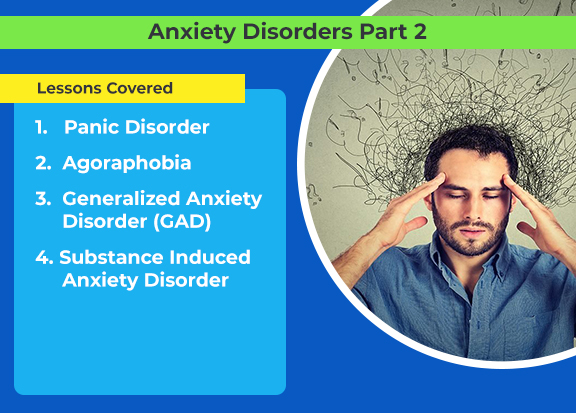
Anxiety Disorders Part 2 presents information on four additional types of Anxiety, one type each day for four days:
- Panic Disorder
- Agoraphobia
- Generalized Anxiety
- Substance Induced Anxiety
On the fifth day, the Team reviews each of the anxiety disorders. This can help you fix the information in your memory and reaffirm the strategies for dealing with each type. Typically, the average adult needs to review information three or four times to move it from short-term memory into long-term memory.