Overview
Overview – Neurodevelopmental Disorder – Communication
A communication disorder is any disorder that affects an individual’s ability to comprehend, detect, or apply language and speech to engage in discourse effectively with others. The delays can range from simple sound substitution to the inability to understand or use one’s native language. The Neurodevelopmental Disorder in communication, is characterized by deficits in the development and use of language, speech, and social communication. Like other neurodevelopmental disorders, communication disorder begins early in life and may produce lifelong functional impairments. It is estimated that nearly one in ten American children has some type of communication disorder.
Some causes of communication disorder include hearing loss, other neurological conditions, brain injury, vocal cord injury, autism spectrum disorder, intellectual disorder, drug abuse, physical impairments such as cleft lip or palate, emotional or psychiatric problem, and developmental disorders. Although research continues, frequently, the cause of a communication disorder is unknown. The DSM-5 generally separates distinct medical and neurological conditions from a communication disorder.
According to the book Speech and Language Disorders in Children, language competence involves two main elements—production or “the ability to encode one’s ideas into language forms and symbols,” and comprehension, “the ability to understand the meanings that others have expressed using language.”
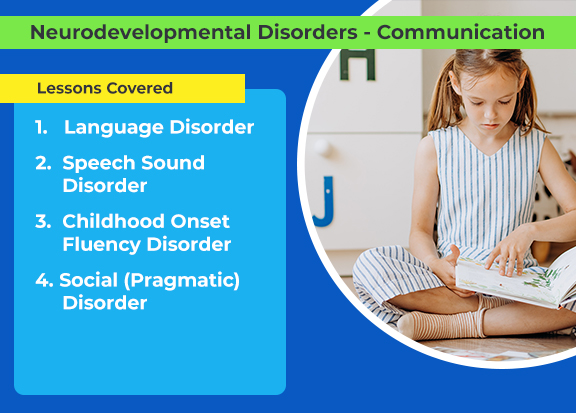
Neurodevelopmental Disorders in Communication presents information on four types of communication disorders, one type each day for four days. These are:
- Language Disorder
- Speech Sound Disorder
- Childhood-Onset Fluency Disorder
- Social (Pragmatic) Disorder
On the fifth day, the Team reviews each Neurodevelopmental Disorder in, Communication, helping you to fix the information in your memory and to reaffirm the strategies for dealing with each type. Typically, the average person needs to review information three or four times to move it from short-term memory into long-term memory.
This concludes the Overview for Neurodevelopmental Disorder in Communication.