Overview
Overview – Anxiety Disorders, Part 1
The word “anxiety” comes from a Latin word that means anxious, distressed, or troubled. Worry is a common synonym for anxiety. In the 17th Century anxiety was considered a pathological condition. Modern psychiatry is said to have used the word since at least 1904. It is a safe guess that from time immemorial, human beings have worried about someone or something—at least sometimes. When was the last time you worried? Did it solve the problem?
The anxiety response involved with anxiety disorders is regulated by two tiny almond-shaped brain organs known as the amygdalae. Normally, they trigger anxiety when danger threatens. For a person with an anxiety disorder, however, the amygdalae recalibrate to a new and higher baseline level of anxiety.
Anxiety is typically linked with the emotion of fear. One of three protective emotions (anger and sadness being the other two), fear is designed to alert you to danger. Unfortunately, the emotion of fear can show up when you are truly in danger or when you simply imagine you are in danger even when that is not true. Some are scared that something bad might happen or fear that something good might not happen. Worrying can keep them awake at night and rob them of needed sleep.
Overall, anxiety disorders are said to be the most common mental disorders on Planet Earth, affecting 1 in every 13 persons worldwide. Just think, if there are 7 billion people living on planet earth, 538,461,538 will experience an anxiety disorder each year. That number represents the number of people who live in the United States of America, Mexico, Canada, and Iraq combined. A 12-year study at Rush University Medical Center showed that individuals who are anxiety-prone showed a 40 percent higher risk of developing a mild cognitive impairment believed to foreshadow Alzheimer’s Disease.
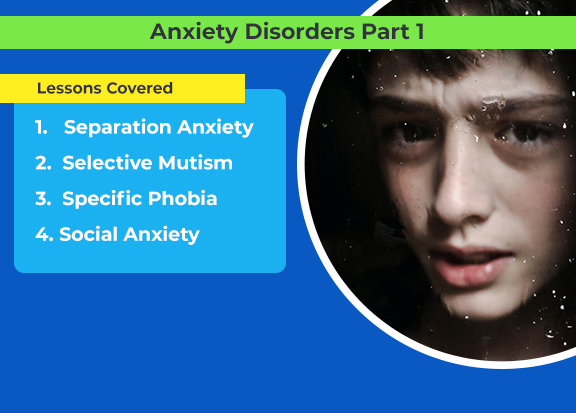
Anxiety Disorders, Part 1, presents information on four different types of Anxiety, one type each day for four days
- Separation Anxiety
- Selective Mutism
- Specific Phobia
- Social Anxiety
On the fifth day, we review each of the anxiety disorders, helping you to fix the information in your memory and to reaffirm the strategies for dealing with each type. Typically, the average adult needs to review information three or four times to move it from short-term memory into long-term memory.
This concludes the overview for Anxiety Disorders, Part 1