Overview
Post-Traumatic Stress Disorder (PTSD) is a trauma and stress-related disorder thought originally to be something only military service members and veterans faced. However, it can happen to anyone, especially those who experience an intense, often life-threatening, event, along with “first responders.” PTSD differs from acute stress disorder in that the experiences are more long-term and will usually disturb daily life. An estimated 7.7 million Americans have suffered or are suffering from PTSD and another eight percent of the population will eventually develop the disorder. PTSD is defined as a type of anxiety disorder triggered by exposure to actual death, the threat of death, serious injury and/or sexual violation. Symptoms can appear as soon as the episode ends or even years later.
The event may be experienced personally or witnessed in person or experienced by hearing about a traumatic event. According to the US National Institute of Mental Health, there are more than 3 million cases of PTSD per year. Prevalence is higher for females (5.2 percent) than for males (1.8 percent). Among adolescents aged 13 through 17, PTSD affects approximately 1 in 20 or 5 percent. About one half of all U.S. adults will experience at least one traumatic event in their lives, but most do not develop PTSD. What makes the difference? Some individuals are at higher risk because they already have existing problems such as anxiety disorders, depression disorders, abuse; blood relatives with mental health problems including anxiety or depression, and the absence of a good support network. Some may have a history of adverse childhood experiences or ACEs; exposure to intense or long-lasting trauma, substance abuse, military personnel, and first responders. Those who do develop PTSA also are at higher risk for developing co-morbid conditions such as eating disorders, issues with drugs or alcohol, anxiety disorders, depressive disorders, and suicidal thoughts and actions. Getting help in a timely manner may prevent some symptoms from developing.
Individuals who experience PTSD may have persistent, frightening thoughts and memories of the event(s), experience sleep problems, feel detached or numb, or may be easily startled. Characterized by intense fear, helplessness, and stress, PTSD can significantly impair one’s normal life and an ability to function at home, work, and socially.
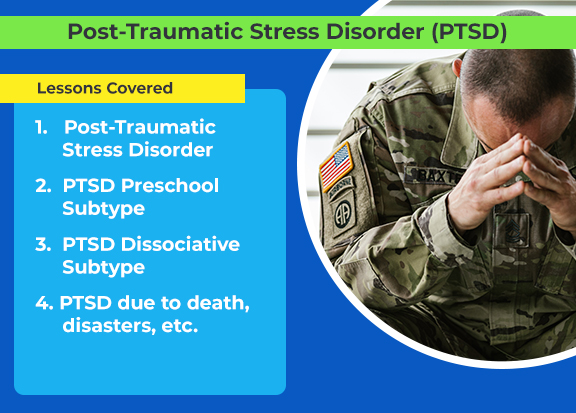
PTSD information addresses four different classifications, one each day for four days:
- Post-Traumatic Stress Disorder
- Post-Traumatic stress Disorder Preschool Subtype
- Post-Traumatic stress Disorder Dissociative Subtype
- Post-Traumatic stress Disorder due to death, disasters, etc.
On the fifth day, the Team reviews each of the four classifications of PTSD to help you to fix the information in your memory and to reaffirm the strategies for dealing with each type. Typically, the average adult needs to review information three or four times to move it from short-term memory into long-term memory.
This concludes the Overview for PTSD