Overview
Overview – Trauma and Stressor Related Disorders
Trauma- and Stressor-Related Disorders include those in which a stressful event is listed explicitly as a diagnostic criterion. This may involve a situation in which a person experiences or witnesses an event that triggers fear for their own or another’s safety. It may be one specific event or a prolonged series or situation. It may involve a human-triggered or natural disaster; being kidnapped or taken hostage; being in a war-torn environment; combat exposure; a threatened or actual physical or sexual assault; being in a serious accident or witnessing any such events. Symptoms may last longer when the trauma is interpersonal and intentional (e. g. in-person or cyberbullying, sexual violence, torture). Emotional and behavioral alterations of some type are to be expected following any traumatic event. For some, however, the reaction(s) can result in significant distress that impairs personal, social, and occupational functioning. Reactions are varied and can include anxiety or fear-based symptoms, aggression or anger-based symptoms, or dissociative symptoms. Anxiety symptoms are not always prominently displayed, however, especially in children. It has been suggested that Trauma- and Stressor-Related Disorders may represent a spectrum, like many other psychiatric conditions.
Hans Selye has been credited as outlining the acute and chronic physiological effects of mental and situational stress. Richard S. Lazarus, Ph.D., has pointed out that stress is a condition, sense, or feeling that is experienced by individuals who perceive that the demands upon them exceed the personal and social resources they are able to mobilize. According to Dr. Al Siebert, there is no stress in any situation until the individual human feels strain—and this differs for every brain. The distress perceived is less the result of what actually exists objectively, and more about what an individual brain perceives is happening.” If symptoms last longer than 30 days, the individual is considered to now be exhibiting PTSD, Post-Traumatic Stress Disorder.
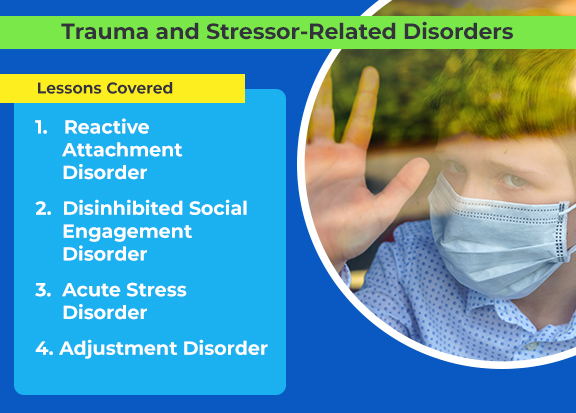
Two main categories of Trauma- and Stressor-Related Disorders have been described. One is PTSD, which is dealt with separately in Module #6. The other involves four different types of Trauma and Stressor Related Disorders, one type presented each day for four days.
- Reactive Attachment Disorder
- Disinhibited Social Engagement Disorder
- Acute Stress Disorder
- Adjustment Disorder
On the fifth day, the Team reviews each of the Trauma- and Stressor-Related Disorders, helping you to fix the information in your memory and to reaffirm the strategies for dealing with each type. Typically, the average adult needs to review information three or four times to move it from short-term memory into long-term memory.
This concludes the Overview for Trauma and Stressor Related Disorders.