Overview
Overview – Schizophrenia Disorders
Much has changed over the last couple of centuries in relation to Schizophrenia Disorders. Just in the last few decades alone, evidence has been accumulating that schizophrenia disorders are biologically based diseases of the brain. Brain imaging has revealed the tissue destruction that occurs in brains that are suffering from schizophrenia. Its etiology or causes along with the pathophysiology or functional changes that occur with this psychotic disorder remain somewhat elusive and are not fully understood.
The specific cause of the disorders in the schizophrenia spectrum are unknown. What is known is that a predisposition to develop schizophrenia is inheritable. When genetic factors are acted upon by a variety of environmental factors, a diagnosis of schizophrenia may result. Environmental factors may include those that occur during gestation, while others may involve Adverse Childhood Experiences or ACE’s.
The clinical manifestations of Schizophrenia Spectrum Disorders are very diverse. The symptoms may vary considerably depending on the individual. Schizophrenia itself remains reliably diagnosable. Several subtypes have been identified that incorporate information that is being learned about the nature of these psychotic mental disorders.
In Schizophrenia Part 1, four types were addressed. They included:
- Schizophrenia Disorder
- Schizoaffective Bipolar Disorder
- Schizoaffective Depressive Type Disorder
- Schizophrenia Substance Induced Disorder
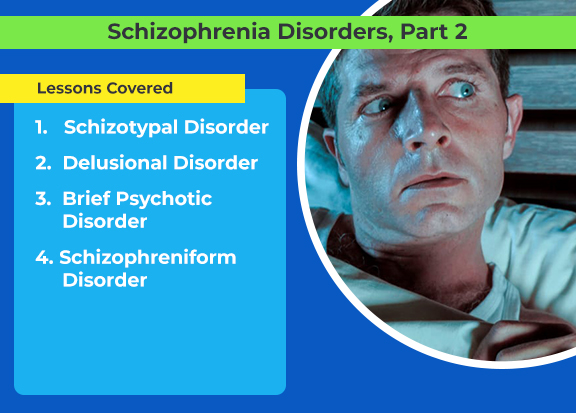
Schizophrenia Disorders, Part 2, presents Information about four additional subtype disorders, one type each day for four days. These are:
- Schizotypal Disorder
- Delusional Disorder
- Brief Psychotic Disorder
- Schizophreniform Disorder
On the fifth day, the Team reviews each of these disorders, helping you to fix the information in your memory and to reaffirm the strategies for dealing with each type. Typically, the average person needs to review information three or four times to move it from short-term memory into long-term memory.
This concludes the Overview for Schizophrenia, Part 2