Overview
Overview – Schizophrenia Disorders, Part 1
The name Schizophrenia is only a couple hundred years old, although descriptions of the disease supposedly relate back to at least Egypt in the time of the Pharaohs. Schizophrenia disorders typically manifest in late teens to early twenties. Infants can present with what are termed soft neurological signs that are predictive of schizophrenia later in life. These signs alone are not definitive, however, as they can be indicative of other neurodevelopmental disorders, such as Autism Spectrum Disorder or sensory deficits, such as hearing impairment. These signs include:
- Lack of eye contact with their care-giver
- Emotional flatness or lack of affect
- Failure to meet developmental milestones for coordination
Prevalence for Schizophrenia and related psychotic disorders in the United States is estimated to range between 0.25 and 1.0 percent. This tends to rise if there is a family history of the disorder, as family history tends to be the number one risk factor for Schizophrenia. Changes in a gene known as C4 have been linked with the disorder. Family studies have revealed that the closer an individual’s genetic relatedness to a person with schizophrenia, the greater the likelihood of developing the disorder. Twin studies have shown that an identical twin has a risk of also developing the disorder that hovers slightly under 50.0 percent. For a fraternal twin the estimate is 17.0 percent; a 9.0 percent risk if a full sibling is diagnosed, and so on. The inheritability, or genetic factor, is linked with other environmental or epigenetic factors.
The clinical manifestations are extremely diverse with symptoms varying with the individual. Several subtypes have been identified that incorporate new information about the nature of these psychotic illnesses. There are two types of schizoaffective disorder, both of which include some symptoms of schizophrenia: Bipolar type which includes episodes of mania and sometimes major depression; and Depressive type, which includes only major depressive episodes
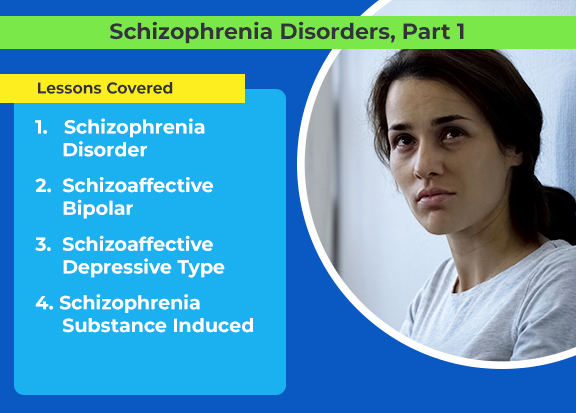
Schizophrenia Disorders, Part 1, presents information on four types of disorders, one type each day for four days. These are:
- Schizophrenia Disorder
- Schizoaffective Bipolar Disorder
- Schizoaffective Depressive Type Disorder
- Schizophrenia Substance Induced Disorder
On the fifth day, the Team reviews each of the four types of Disorders, helping you to fix the information in your memory and to reaffirm the strategies for dealing with each type. Typically, the average person needs to review information three or four times to move it from short-term memory into long-term memory.
This concludes the Overview for Schizophrenia Disorders, Part 1.