Overview
Overview – Neurocognitive Disorders, Part 1
Neurocognitive Disorders are a category of disorders that primarily affect cognitive abilities. They are not developmental conditions but are acquired conditions representing underlying brain pathology that results in a decline in functioning from a previously attained level of cognitive (mental) functioning. Diagnosis requires that symptoms must be associated with a medical condition and not another mental health problem, and there cannot be evidence of delirium, which is a separate, temporary disorder with similar symptoms.
Two categories are recognized: Mild and Major. They exist on a spectrum of cognitive and functional impairment. At the Mild Neurocognitive Disorders level, the individual is likely to describe their everyday tasks as being more difficult or as requiring extra time or effort or compensatory strategies. Neurocognitive deficits in mild neurocognitive disorder do not interfere with the capacity for independence in everyday activities, although the individual usually functions at a suboptimal level, with the tasks becoming more fatiguing. A Mild Neurocognitive Disorders may or may not progress to a major neurocognitive disorder. A Major Neurocognitive Disorders shows a serious decline from a previous level of cognitive performance, interfering with independence in everyday activities, and requiring more assistance with complex activities. Some activities may need to be abandoned altogether.
Neurocognitive Disorders involve six areas of cognitive function including:
- Executive function – difficulties with planning
- Learning and memory – inability to make decisions
- Perceptual-motor function – trouble focusing on tasks
- Language – inability to remember names of objects and people
- Complex attention – struggling to perform daily tasks
- Social cognition – speaking or behaving in socially unacceptable ways.
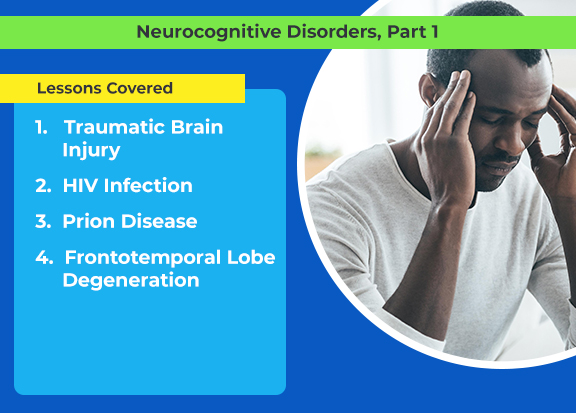
Neurocognitive Disorders, Part 1, presents information about four types of Neurocognitive Disorders, one type each day for four days. These are:
- Neurocognitive Disorder Due to Traumatic Brain Injury
- Neurocognitive Disorder Due to HIV Infection
- Neurocognitive Disorder Due to Prion Disease
- Frontotemporal Neurocognitive Disorder
On the fifth day, the Team reviews each of the four neurocognitive disorders, helping you to fix the information in your memory and to reaffirm the strategies for dealing with each type. Typically, the average person needs to review information three or four times to move it from short-term memory into long-term memory.