Overview
Overview – Dissociative Disorders
Dissociative Disorders are mental illnesses that involve experiencing a disconnection and a lack of continuity between thoughts, memories, surroundings, actions, and identity. Dissociative disorders usually develop as a way to cope with trauma. Risk factors include being subjected to long-term physical, sexual, or emotional abuse; or a home environment that’s frightening or highly unpredictable; or war, natural disasters, kidnapping, torture, or extended, traumatic, early-life medical procedures.
Since personal identity is still forming during childhood, children are more able than an adult to step outside of themselves and observe trauma as though it’s happening to another person. A child who learns to dissociate in order to endure a traumatic experience may use this coping mechanism in response to stressful situations throughout life.
Symptoms—ranging from amnesia to alternate identities—depend in part on the type of dissociative disorder. Symptoms can be profoundly distressing, may last only a few moments, or come and go over many years. They tend to worsen with stress:
- Amnesia of certain time periods, events, people and personal information
- A sense of being detached from the self and emotions
- A perception of the people and things around you as distorted and unreal
- A blurred sense of identity
- Significant stress or problems in relationships, work, or other areas of life
- Inability to cope well with emotional or professional stress
- Mental health problems, such as depression and anxiety
- Suicidal thoughts and behaviors
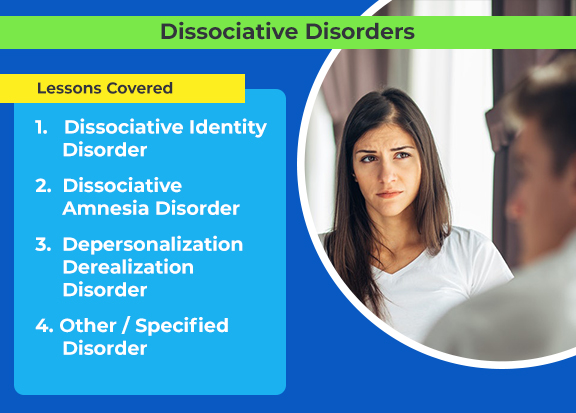
Dissociative Disorders presents information on four types of disorders, one type each day for four days. These are:
- Dissociative Identity Disorder
- Dissociative Amnesia Disorder
- Depersonalization Derealization Disorder
- Other / Specified Disorder
On the fifth day, the Team reviews each of the four dissociative disorders, helping to fix the information in your memory and to reaffirm the strategies for dealing with each type. Typically, the average person needs to review information three or four times to move it from short-term memory into long-term memory.
This concludes the Overview for Dissociative Disorders.