Overview
Overview – Sleep-Wake Disorders, Part 2
The various types of Sleep-Wake Disorders in Part 2 are characterized by disturbed sleep involving quality, timing, or duration. There is a bidirectional link between sleep disorders and coexisting psychiatric and/or medical illnesses. Sleep deprivation is a major risk factor for many medical conditions including heart disease, stroke, diabetes, kidney disease, osteoarthritis, common infections like flu and pneumonia, disorders of the musculoskeletal system, and chronic obstructive pulmonary disease. Sleep deprivation is also linked with mental disorders including Parkinson’s Disease, Alzheimer’s Disease, anxiety disorders, and depressive disorders. Sleep disorders are also an established risk factor for the subsequent development of common mental illnesses and may represent the prodromal expression of an episode of mental illness.
Unlike a coma, sleep is a quiet, partially-conscious, and reversible state from which one can be aroused by stimulation—albeit sometimes with difficulty—because sensitivity to environmental stimuli such as sounds, smells, and physical sensations is lowered but not completely blocked. Estimates are that most humans will spend about a third of their life sleeping—important to help them be productive during the remaining two-thirds of their life. Estimates are that 17.0 percent in the general population in the United States have a sleep apnea disorder.
Sleep-Wake Disorders, Part 1, presented information on four types of disorders, one type each day for four days. These were:
- Insomnia Disorder
- Hypersomnia Disorder
- Narcolepsy Disorder
- Circadian Rhythm Sleep Disorder
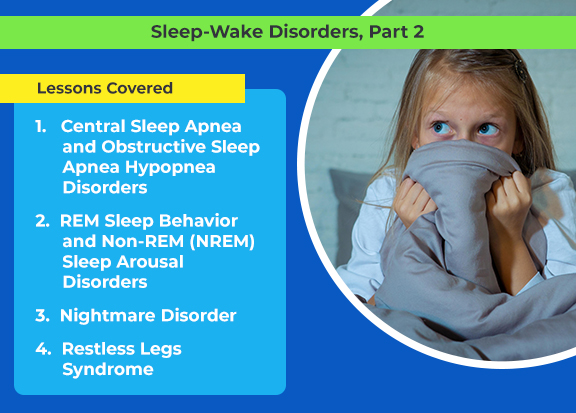
Sleep-Wake Disorders, Part 2, presents information on six additional types of disorders, Two Related types each for days one and two, and one type each day for days three and four. These are:
- Central Sleep Apnea and Obstructive Sleep Apnea Hypopnea disorders
- REM Sleep Behavior Disorder and Non-REM Sleep Arousal Disorders
- Nightmare disorder
- Restless legs syndrome
On the fifth day, the Team reviews each of the additional types of Sleep-Wake Disorders, helping you to fix the information in your memory and to reaffirm the strategies for dealing with each type. Typically, the average person needs to review information three or four times to move it from short-term memory into long-term memory.