Overview
Overview – Obsessive-Compulsive and Related Disorders (OCD), Part 2
Obsessive-Compulsive and Related Disorders are a group of mental illnesses that are in the Obsessive-Compulsive Disorder spectrum. They are characterized by obsessions, or compulsions, or both. The individuals experience recurrent and persistent thoughts, urges or images that are experienced, at some time during the disturbance, as intrusive, unwanted, and that in most individuals cause marked anxiety or distress. There are attempts to ignore or suppress such thoughts, urges, or images, or to neutralize them with some thought or action (i.e., by performing a compulsion). The obsessions or compulsions are time-consuming (e.g., take more than one hour per day) or cause clinically significant distress or impairment in social, occupational, or other important areas of functioning.
Obsessive-Compulsive Disorders are quite common with over three million cases diagnosed per year in the United States. OCD can last several years or be lifelong. The specific cause of OCD is unknown, but genetic changes and family history have been noted in some cases. Symptoms can be mild and gradually progress in severity. Stress appears to worsen the symptoms, which include:
- Persistent, repeated, and unwanted thoughts
- Urges or images that are intrusive
- Compulsive or ritualistic behavior to get rid of the thoughts
In Obsessive-Compulsive and Related Disorders, Part 1, information was presented on four disorders. There were:
- Obsessive-Compulsive Disorder
- Body Dysmorphic
- Hoarding
- Other Specified/Unspecified
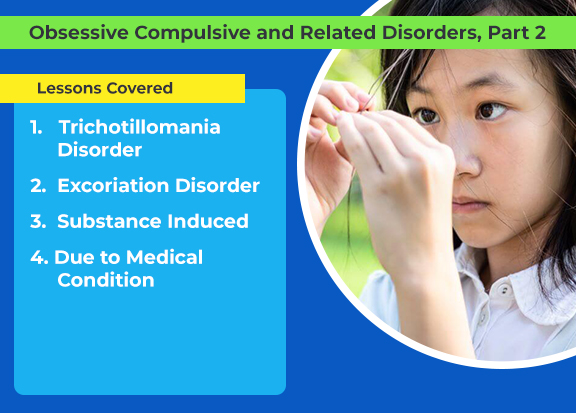
In Obsessive-Compulsive and Related Disorders, Part 2, information on four additional disorders are presented, one type each day for four days. These are:
- Trichotillomania Disorder
- Excoriation Disorder
- Substance Induced
- Due to Medical Condition
On the fifth day, the Team reviews each of the four additional disorders, helping you to fix the information in your memory and to reaffirm the strategies for dealing with each type. Typically, the average person needs to review information three or four times to move it from short-term memory into long-term memory.
This concludes Overview of Obsessive-Compulsive and Related Disorders, Part 2